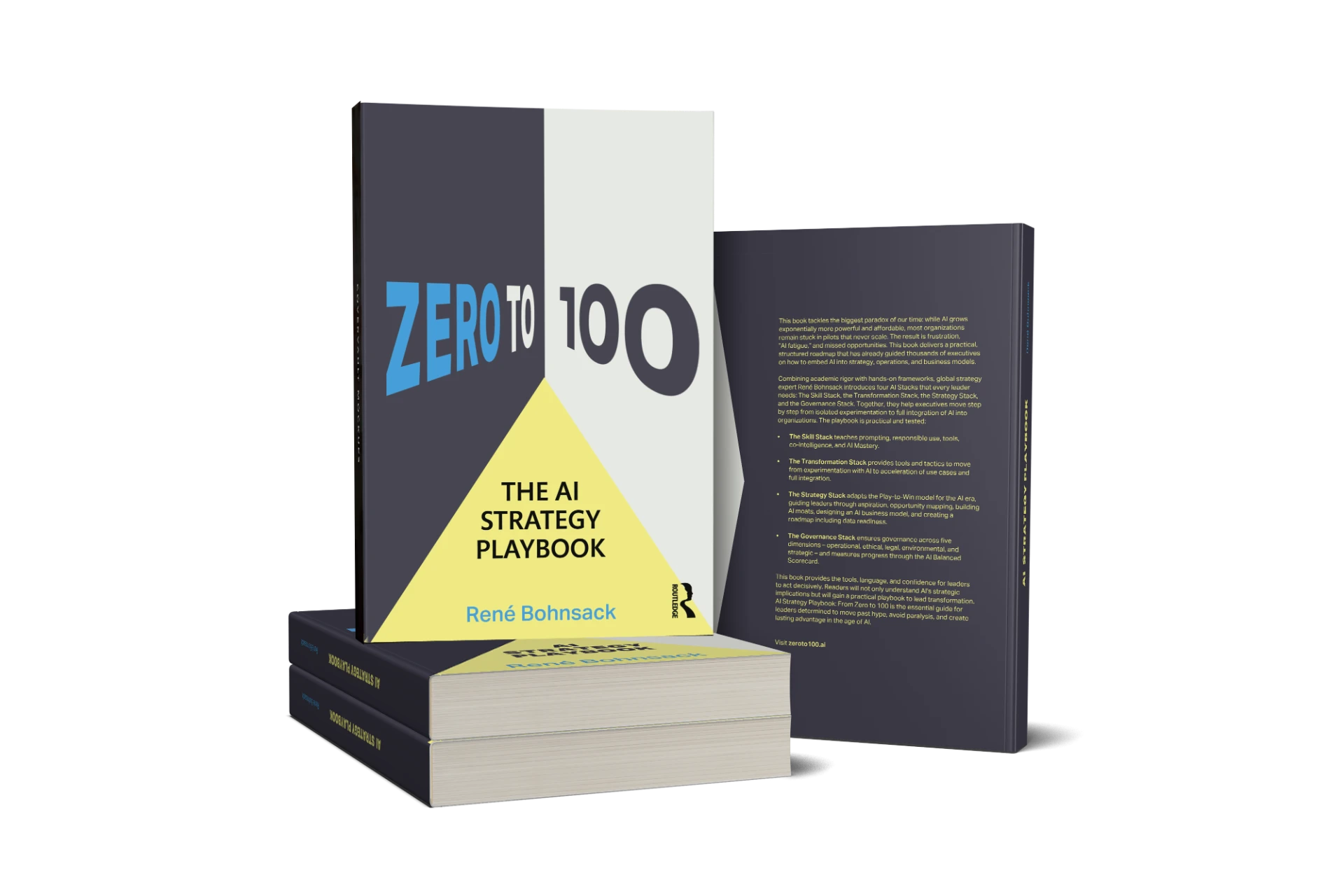
The AI Strategy Playbook by René Bohnsack: front cover, spine and back cover

The AI Strategy PlaybookFrom Zero to 100

A practical, structured roadmap for embedding AI into strategy, operations and business models. Four AI Stacks take a leadership team step by step from isolated experimentation to full integration.

Publisher
Routledge
Publication date
1 September 2026
Extent
248 pages, 48 illustrations
Paperback ISBN
978-1-041-27390-5
Hardback ISBN
978-1-041-29651-5
Ebook ISBN
978-1-003-77059-6
DOI
10.4324/9781003770596
Order the book

The book

Academic rigor, hands-on frameworks

The AI Strategy Playbook combines academic rigor with hands-on frameworks. It introduces the four AI Stacks that every leader needs, and it moves an organization step by step from isolated experimentation to full integration of AI.

The playbook is practical and tested. It gives leaders the tools, language and confidence to act, and a clear route from experimentation to lasting advantage.

“The paradox is not that AI is failing organisations. It is that organisations are failing to organise themselves around AI.”

The AI Strategy Playbook, p. 12

Nearly 2 in 3 firms are stuck experimenting with AI, running pilots and isolated proofs of concept.

Source: Accenture, survey of 1,200 firms (2022), cited in The AI Strategy Playbook, p. 12.

Four AI Stacks

Together they take an organization from isolated experimentation to full integration.

01

Skill

Prompting, responsible use, tool use, co-intelligence and AI mastery.

02

Transformation

Tools and tactics to move from experimentation with AI, to acceleration of use cases including agentic AI, to full integration.

03

Strategy

The Play-to-Win model adapted for the AI era: aspiration, opportunity mapping, the construction of AI moats, the design of an AI business model, and a roadmap that includes data readiness.

04

Governance and Control

Governance across five dimensions: operational, ethical, legal, environmental and strategic. Progress is measured through the AI Balanced Scorecard.

Contents

Preface · Use of Generative AI Tools · How to Read This Book

Introduction

AI Fundamentals for Decision Makers

Part 1The Skill StackChapters 1 to 5
Part 2The Transformation StackChapters 6 to 8
Part 3The Strategy StackChapters 9 to 10
Part 4The Governance and Control StackChapters 11 to 12

Conclusion: Your Journey from Zero to 100, including the 10 Principles

Glossary · References and Further Reading · Index

Inside the book

Six frameworks to use with your leadership team

01 · Introduction

The Zero to 100 Matrix

Two dimensions decide who gets value from AI: AI Capabilities, what your organization can actually do, and AI Direction, whether those capabilities are pointed somewhere. That gives four positions. Observers are low in both. Thinkers know what they want and have not operationalised it. Doers deliver use cases without alignment. Leaders are high in both, and on the way to 100.

02 · The Skill Stack

CRAFT

The five elements of any prompt: Context, Role, Action, Format, Tone. The book calls it the foundational grammar of effective prompting.

03 · The Skill Stack

The AI Compass

Four directions of responsible use, and one test before anything goes into an unapproved tool: would I email this to a stranger? If the answer is no, stop.

04 · The Transformation Stack

The three phases

Experimentation, Acceleration, Integration. Each phase has its own culture tactics, technology tactics and metrics, and you cannot skip one.

05 · The Strategy Stack

The Arena, and the TOWS reversal

Map the outside world first, then assess honestly whether you are equipped to compete in it. The confrontation matrix produces four quadrants to act on: Attack, Defend, Enhance and Turn Around.

06 · The Governance and Control Stack

STORI, the AI Balanced Scorecard

Five dimensions that make AI progress measurable: Strategy, Technology and Data, Organization, Responsibility and Innovation. The book includes a fully worked scorecard for a bank.

What 100 means

Zero is the bottom left of the Zero to 100 Matrix: no capability, no direction. 100 is the top right, where mature AI capabilities meet a direction that turns them into advantage. The book gives the route between them in one line.

(Skills × Transformation) + (Strategy × Governance) = AI Advantage

Capability comes from the first bracket. Direction comes from the second.

Who it is for

01

Executives and boards

Leaders accountable for an AI agenda who need a defensible plan.

02

Transformation and innovation leads

People running a portfolio of AI use cases.

03

Founders and senior specialists

Builders who want the strategy language to match the technical work already underway.

Bulk orders

Copies for a team, a program or an event: tell us what you need and we will send a quote.